

Level 3 Certificate in Oil & Gas Operational Safety
Develop Advanced Safety Skills for Oil & Gas Operations
Build professional knowledge of operational safety, hazard identification, risk assessment, permit-to-work systems, process safety and emergency response with the Level 3 Certificate in Oil & Gas Operational Safety.
Develop the skills needed to understand and manage safety risks across oil and gas operational environments while supporting safe and compliant workplace practices.
Course Overview
The Level 3 Certificate in Oil & Gas Operational Safety is designed for learners and safety professionals who want to develop a stronger understanding of health and safety requirements within oil and gas operational environments.
The course goes beyond basic safety awareness and focuses on the practical management of hazards encountered during oil and gas activities. Topics commonly include hazard identification, risk assessment, process safety, permit-to-work systems, isolation procedures, confined spaces, working at height, lifting operations, hazardous substances, fire and explosion hazards, gas detection and emergency response.
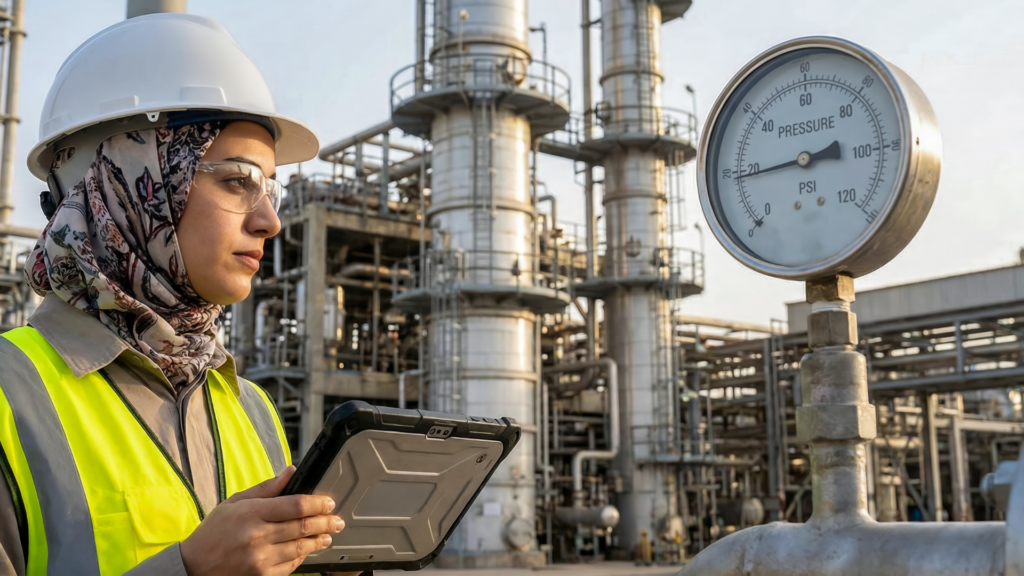
Learners also develop an understanding of how operational safety procedures are implemented and monitored, including the importance of safe systems of work, toolbox talks, method statements, risk controls, personal protective equipment (PPE), incident reporting and emergency preparedness.
The course is particularly relevant to operational environments such as drilling, exploration, production, processing, refining, storage, transportation and maintenance.
For professionals in Pakistan, the Level 3 Certificate in Oil & Gas Operational Safety can be valuable for individuals working or seeking opportunities in oil and gas companies, refineries, petrochemical facilities, drilling operations, pipelines, terminals and industrial maintenance.
If you are searching for a Level 3 Oil & Gas Safety course in Pakistan, Oil and Gas Operational Safety training in Islamabad or Rawalpindi, or professional HSE training for the energy sector, IUK Safety Ventures provides structured training designed to support your career development.
Duration
The duration of a Level 3 Certificate in Oil & Gas Operational Safety can vary depending on the awarding organisation, qualification structure, guided learning hours and assessment requirements. Professional Level 3 programmes may be delivered over several days to several weeks, depending on the study format and curriculum.
For detailed class timings, upcoming batches, training schedules, and available study options, please contact the IUK Safety Ventures admissions team. Our advisors will be happy to guide you and help you choose the batch that best fits your schedule.
Eligibility
The Level 3 Certificate in Oil & Gas Operational Safety is generally more suitable for learners who already have some understanding of workplace health and safety or technical operations.
Depending on the specific awarding organisation, entry requirements may vary. A formal university degree is not necessarily required, but relevant Level 2 safety training, technical education or workplace experience can be advantageous.
The course is particularly suitable for:
- HSE Officers
- Safety Officers
- HSE Supervisors
- Oil & Gas Workers
- Drilling Personnel
- Refinery Workers
- Process Plant Operators
- Production Personnel
- Maintenance Personnel
- Pipeline Workers
- Site Supervisors
- Permit-to-Work Coordinators
- Safety Supervisors
- Technical Personnel
- Contractors working in oil and gas
- Professionals progressing from Level 2 safety training
Previous experience in oil and gas operations, HSE, engineering or industrial safety can be highly beneficial.
For applicants in Pakistan, the IUK Safety Ventures admissions team can review your educational and professional background and guide you regarding the most suitable entry pathway.
Learning Outcomes
The Level 3 Certificate in Oil & Gas Operational Safety develops practical knowledge for identifying and managing operational safety risks within the oil and gas industry.
After completing the course, learners will be able to:
- Understand the principles of operational safety in the oil and gas industry.
- Identify hazards associated with oil and gas operations.
- Conduct basic workplace hazard identification and risk assessment.
- Understand the hierarchy of controls.
- Apply safe systems of work.
- Understand permit-to-work systems and their importance.
- Understand isolation and energy-control principles.
- Recognise fire and explosion hazards.
- Understand hazardous substance and chemical risks.
- Understand H₂S and other toxic-gas hazards.
- Recognise confined-space hazards and control measures.
- Understand working-at-height risks.
- Recognise lifting and material-handling hazards.
- Understand basic process safety principles.
- Understand the importance of gas detection and atmospheric monitoring.
- Apply appropriate PPE requirements.
- Understand emergency preparedness and response procedures.
- Recognise the importance of toolbox talks and safety communication.
- Understand incident and near-miss reporting.
- Support effective safety inspections and workplace monitoring.
- Identify unsafe conditions and recommend appropriate controls.
- Support continual improvement of operational safety performance.
Career Opportunities
The Level 3 Certificate in Oil & Gas Operational Safety can support career progression in the oil and gas, energy, petrochemical and industrial safety sectors.
Depending on qualifications, experience and employer requirements, learners may pursue roles such as:
- HSE Officer
- Safety Officer
- HSE Supervisor
- Safety Supervisor
- Oil & Gas Safety Officer
- HSE Coordinator
- Site Safety Coordinator
- Permit-to-Work Coordinator
- Oil & Gas Operations Safety Assistant
- Drilling Safety Personnel
- Refinery Safety Personnel
- Process Safety Support Personnel
- Industrial Safety Officer
- Site Supervisor
- HSE Advisor
The qualification can be particularly valuable for professionals seeking opportunities in Pakistan and international oil and gas markets, including the Middle East.
Learners can further strengthen their careers through qualifications such as NEBOSH IGC, IOSH Managing Safely, OSHA training, H₂S Safety, Level 3 Petrochemical Safety, Process Safety and other specialised HSE qualifications.
Why Choose IUK Safety Ventures?
Choosing the right training provider is just as important as choosing the right qualification. At IUK Safety Ventures, we are committed to delivering high-quality professional education that prepares learners for real-world challenges and long-term career success.
Whether you are starting your journey in occupational health and safety or looking to enhance your professional profile, IUK Safety Ventures provides the knowledge, guidance, and confidence you need to achieve your goals.
What Sets Us Apart?
- Experienced and Qualified Health & Safety Trainers
- Internationally Recognized UK Qualifications
- Practical, Industry-Focused Learning Approach
- Modern Learning Environment
- Flexible Study Options
- Personalized Student Support
- Career-Oriented Training
- Commitment to Student Success
Take the Next Step in Oil & Gas Safety
Develop the skills to identify operational hazards, assess risks, implement safety controls and support safe oil and gas operations.
Build expertise in risk assessment, permit-to-work systems, process safety, hazardous substances, H₂S awareness, emergency response and safe systems of work.
Join IUK Safety Ventures for the Level 3 Certificate in Oil & Gas Operational Safety in Pakistan and take the next step toward a career in oil and gas HSE and operational safety.